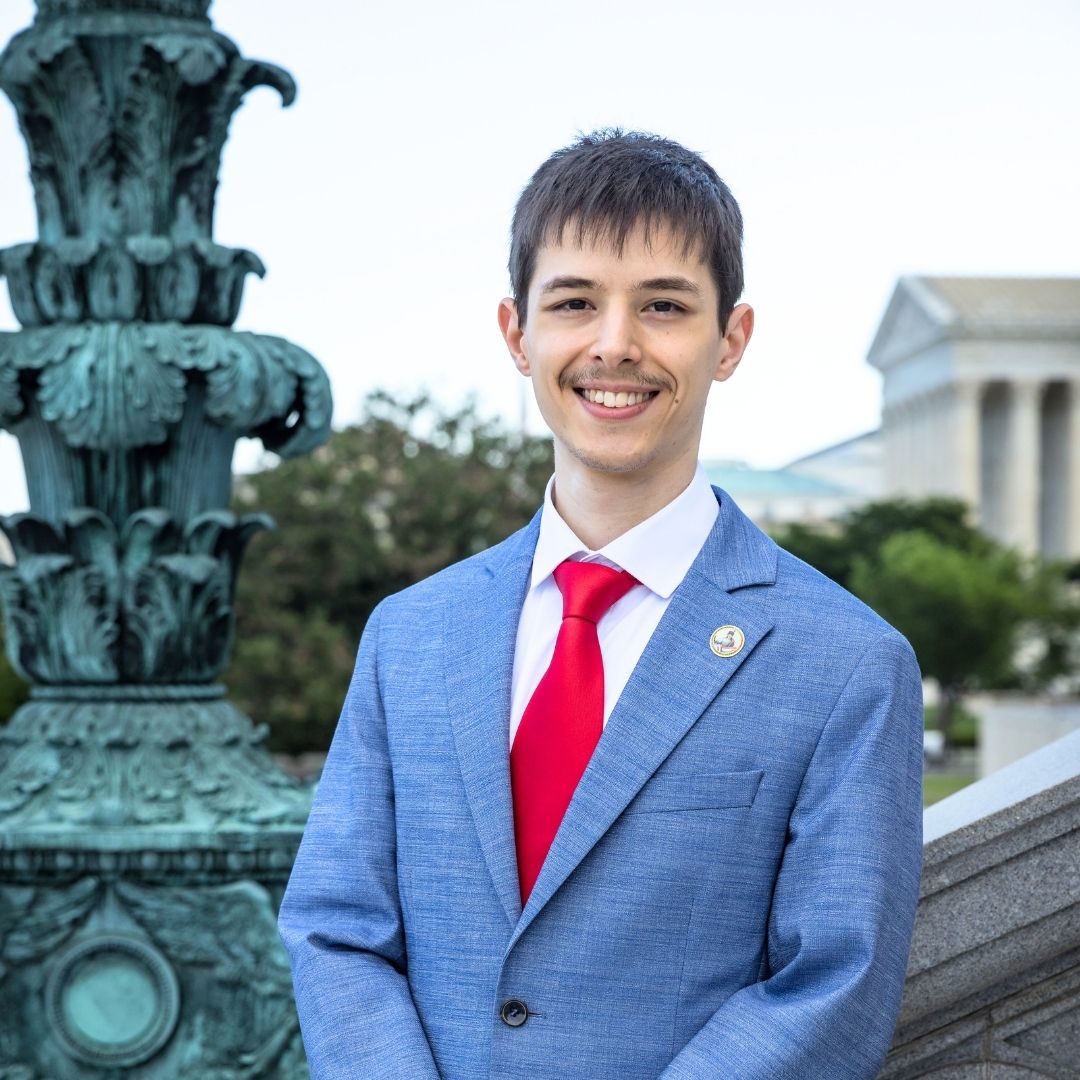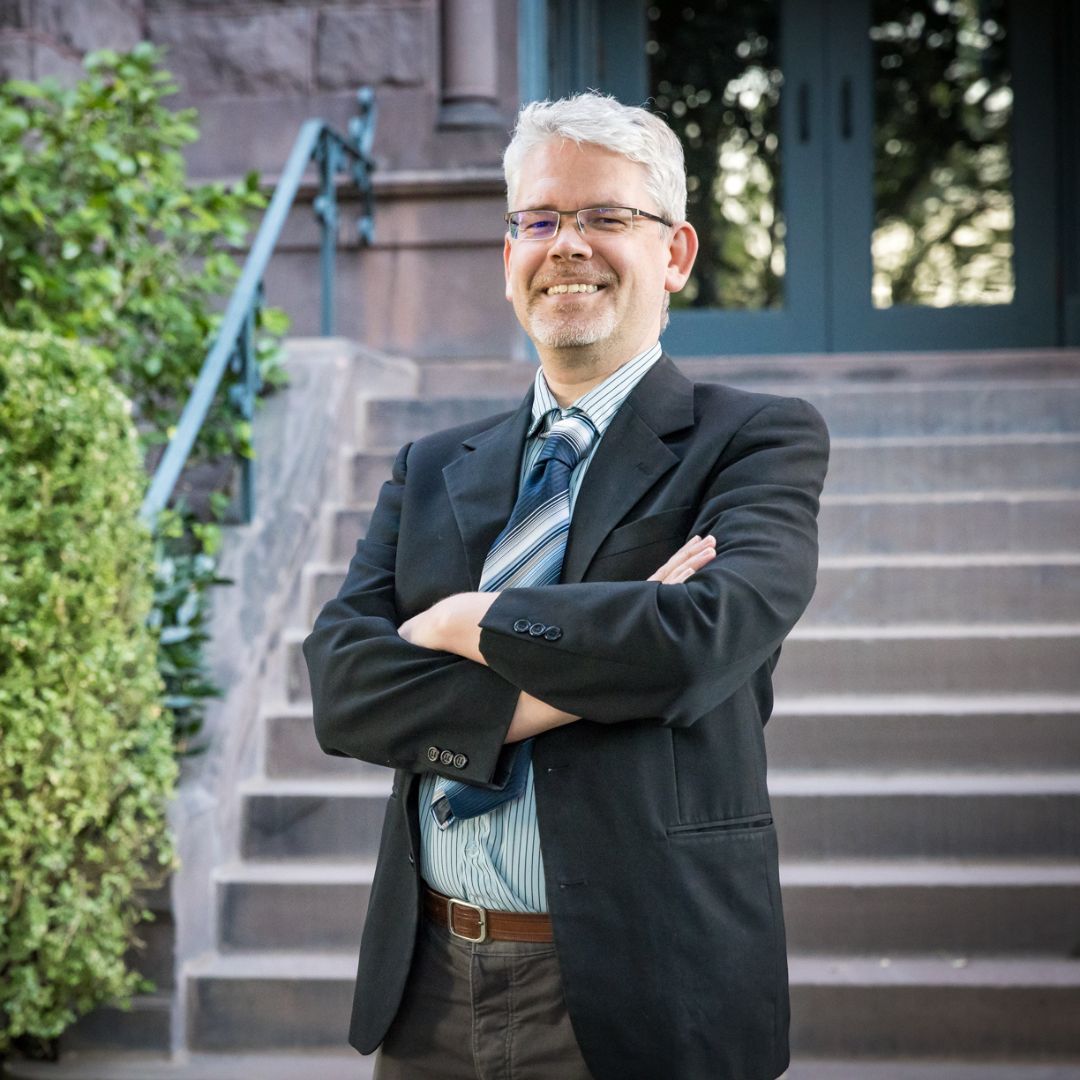
Featured Alumni

Augmented AR Holocaust Memory Project “If These Streets Could Talk” Debuts in DC

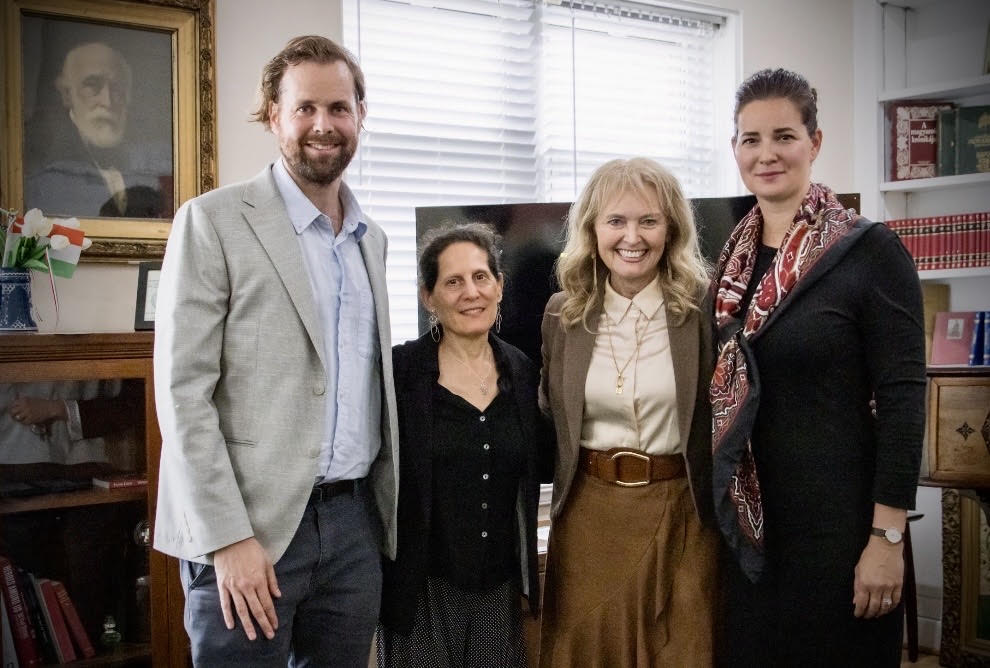
HF Alumnus Barna Szász, Nancy Gillette (USHMM), Katrina Lantos Swett, Anna Smith Lacey

On September 23, a full house gathered at Kossuth House in Washington, D.C., for “Augmented Reality & Holocaust Memory: Inside the Museum and Out on the Street.” The afternoon looked at how augmented reality (AR) can bring people closer to Holocaust history in two settings: a gallery of the United States Holocaust Memorial Museum, and the streets of Budapest’s former Jewish ghetto. There, three Hungary Foundation alumni are building If These Streets Could Talk: director Barna Szász and producers Máté Artur Vincze and Noémi Szakonyi. Hungary Foundation Executive Director Anna Smith Lacey moderated the discussion.

Dr. Katrina Lantos Swett, President of the Lantos Foundation for Human Rights & Justice, opened the program by speaking about members of her family who were lost in the Holocaust. She is one of the last people, she said, for whom this history is not distant. Every morning she has breakfast with her mother, a survivor, who is now 95.

Nancy Gillette, Special Exhibitions Manager at the Museum, presented the AR experience added to the Museum’s Tower of Faces exhibition. Work on it began in 2018, early for a museum of that size. With a tablet, visitors can now read and hear the stories of the people in the photographs. Gillette said those who use it spend five times as long in the Tower as those who don’t.

Szász, who now teaches AR storytelling at Stanford, explained why a documentary filmmaker would turn to augmented reality. In 2018, as a Fulbright scholar and Hungary Foundation graduate fellow, he saw an experiment in Jeremy Bailenson’s Virtual Human Interaction Lab at Stanford. People who had interacted with a virtual person sit in a real chair would not sit in that chair themselves, and most still avoided it after taking the headset off. To Szász, it showed that a virtual layer can change how people see the physical world around them. He started exploring AR to show histories that can no longer be seen in the places where they happened, first on the Stanford campus and later in Budapest’s Jewish quarter. AR, he said, is a new medium with its own language, different from film or anything that came before, and he has been learning that language together with his students.

If These Streets Could Talk puts that knowledge to work in Budapest. Szász described it as a new way for people to connect with the history of their cities, built on storyliving rather than storytelling. Characters from 1903 to 1944 walk up to visitors on the streets of the former Jewish quarter, and visitors have to make the decisions those people faced.

Joining by video, Prof. Victoria Grace Richardson-Walden, Director of the Landecker Digital Memory Lab at the University of Sussex and the project’s ethics lead, described how the team made If These Streets Could Talk into the first scientific research project on AR-native methods of Holocaust memory, meaning methods built for what AR can do that older media cannot. Its storyliving approach, and the ethical questions it raises, were tested in interviews with sixty participants. The results, she said, show that AR can deepen people’s understanding of the places where events happened and leave room for critical reflection. It also moves them emotionally, which makes them want to learn more.

The full experience opens to the public in Budapest in 2028.

We thank Dr. Katrina Lantos Swett, Nancy Gillette and Prof. Victoria Grace Richardson-Walden, and everyone who joined us for the event. 

To support If These Streets Could Talk, visit if-these-streets.org/donate.


Support the project

Across Europe, streets and squares once alive with Jewish life have gone silent. When history becomes invisible, it is forgotten — and that creates fertile ground for misrepresentation.

If These Streets Could Talk is a new, tested methodology for future-proofing Jewish heritage and Holocaust memory through Augmented Reality. In Budapest’s former Jewish Quarter, audiences walk the actual streets and encounter holographic characters and 3D-reconstructed environments, past and present side by side — every scene rooted in archival evidence and survivor testimony.

The approach is validated, we are in main production, and Budapest is our proof of concept, not our ceiling. This is where we need you.

$60,000of $200,000 to be matched in 2026

Updated daily · Last updated 21 September 2026

$1.4 million secured

Between 2022 and 2026 we built three AR prototypes and tested them scientifically with audiences. The methodology is validated.

Every dollar is doubled — until it isn’t

$450,000 of our funding only counts if we match it. $200,000 needs to be matched in 2026 and $250,000 in 2027. After that the match closes and the doubling is gone.

Choose what your donation goes toward

Each part of the work is funded by many donations together. Pick the one you want to be part of.

$100→$200

ONE ADDRESS

Please help contribute to the historical and visual research of one address, and to the 3D reconstruction of its shop fronts and signs.

Give $100

$500→$1,000

LIDAR SCANNING

Please help contribute to the high-quality LiDAR scanning of Budapest’s Jewish quarter.

Give $500

$1,000→$2,000

EDUCATION

Please help contribute to the educational methodology we are co-developing with the Haver Foundation.

Give $1,000

$5,000→$10,000

OPEN PLATFORM

Please help contribute to the interactive, non-profit AR platform that other cities can use for their own Jewish heritage.

Give $5,000

$10,000→$20,000

VOLUMETRIC SHOOT

Please help contribute to the volumetric 4DGS shoot that brings the historical characters to life as photorealistic holograms.

Give $10,000

Any amount

Every donation is matched while the match lasts, whatever its size — you choose the amount.

Give any amount

Donations made here go to Párhuzamos Történetek Kulturális Egyesület, the non-profit association behind the project.

Donors in the US: for a tax-deductible donation, please donate through our fiscal sponsor Edge of Discovery, a 501(c)(3) public charity in Utah — write to hello@barnaszasz.com and we’ll send you the details.

Considering a larger donation? Meet director Barna Szász for 30 minutes, in person or on Zoom, or write to hello@barnaszasz.com.



Laura Mészáros

Program: Széll Kálmán Public Policy Fellowship

Year: 2026 Summer

Host Institution: International Foundation for Electoral Systems

Research Focus: Economics and U.S. Foreign Policy

Quote: “I have a strong interest in campaign strategy and believe politics should feel more understandable and approachable for everyday people. In the long term, I hope to contribute to projects that help people engage with public life in a healthier and more constructive way. Ultimately, I hope my work will leave behind something useful and meaningful for others.”

Read her introduction here: hungaryfoundation.org

Laura Mészáros is pursuing her law degree at Széchenyi István University in Győr, Hungary. Her academic interests began to take shape during her years at Krúdy Gyula Secondary School, where she became fascinated by history, international relations, sociology, psychology, and politics. She believes that history is one of the most valuable disciplines because it not only helps societies understand the present but also offers insight into future political and social developments. Looking back, she considers her high school environment especially formative: the coexistence of vocational and academic education within the same institution reflected the duality that would later define many of her own interests and experiences.

Alongside her legal studies, Laura entered the international fashion industry as a high fashion model, working in cities including Shanghai, Hong Kong, Athens, Istanbul, and Budapest. Through international campaigns and creative productions, she gained firsthand experience in multicultural environments and had the opportunity to observe the inner workings of marketing, public relations, branding, and production processes behind the scenes. While the fashion and film industries initially meant a creative outlet, these experiences also deepened her awareness of labor rights and human rights issues within global industries.

IFES envisions a world where people are free, societies are democratic, and elections are fair. They collaborate with civil society, public institutions, and the private sector to build resilient democracies that deliver for everyone. As a global leader in the promotion and protection of democracy, their technical assistance and applied research develop trusted electoral bodies capable of conducting credible elections; effective and accountable governing stakeholders; civic and political processes in which all people can safely and equally participate; and innovative ways in which technology and data can positively serve elections and democracy.

Levente Tóth

Program: Széll Kálmán Public Policy Fellowship

Year: 2026 Summer

Host Institution: American Short Line and Railroad Association

Research Focus: Business and Government Relations

Quote: “Through the Széll Kálmán Fellowship, I hope to better understand how American public institutions, investors, entrepreneurs, and industry organizations cooperate to support innovation and economic growth. During my time in Washington, D.C., I am especially interested in learning how public policy shapes the venture capital environment, how public–private partnerships can support startup growth, and how successful institutional models could later be adapted to Hungary.”

Read his introduction here: hungaryfoundation.org

Levente is a fourth-year undergraduate student at Corvinus University of Budapest, where he studies International Business Economics in English. His academic path has been shaped by a strong interest in the intersection of finance, entrepreneurship, and public policy. His studies have also taken him abroad: he spent an exchange semester at the Stockholm School of Economics, where he studied startup-related courses in an international environment. Alongside his university studies, Levente has actively sought practical experiences that connect business, innovation, and public affairs. He previously worked as a Finance Intern at Morgan Stanley in Budapest and currently works as a Business Development Associate at WiredSign Zrt., a Hungarian contract lifecycle management company, where he contributes to building the company’s financial model, advising on business strategy, conducting customer interviews, supporting fundraising activities, and coordinating external partners. He has also completed several startup, venture capital, consulting, and M&A-focused programs, including the Hungarian Startup University Program, Niveus Startup Valuation Course, Wolf Theiss M&A Course, and Deloitte Consulting Course, where he received a “Best-Performing Student” award.

Founded in 1913, ASLRRA proudly represents the entrepreneurial owners and operators of short line and regional railroads throughout North America. These approximately 600 small businesses play a vital role in the hub-and-spoke transportation network, often providing the first-mile/last-mile connection between farmers and manufacturers and the ultimate consumer.

Csenge Balogh

Program: Széll Kálmán Public Policy Fellowship

Year: 2026 Summer

Host Institution: American Legislative Exchange Council

Research Focus: Foreign Policy

Quote: “My philosophy is lifelong learning: absorbing something new every day, developing my own ideas and perspectives about the world, with the goal of becoming an active shaper of the future.”

Read her introduction here: hungaryfoundation.org

Csenge Orsolya Balogh is completing her second year in International Business and Economics at Corvinus University of Budapest while also being a student at Rajk College for Advanced Studies. Her intellectual interests lie at the intersection of economics, public policy, and health.

Driven by this belief, she first explored this professionally by supporting VitrofluidiX, a health- tech startup, with market research through the Creative Destruction Lab program organized by ESMT Berlin. Wanting to bring this passion closer to her own community, she participated in the Design Terminal startup competition with a social startup idea aimed at building stronger student communities through sport, addressing the need for belonging and connection among Hungarian college students. Alongside this, she served as project leader of MOVE at MCC, coordinating a team of fifty students and organizing sports events and community programs.

The American Legislative Exchange Council is America’s largest nonpartisan, voluntary membership organization of state legislators dedicated to the principles of limited government, free markets and federalism. Comprised of nearly one-quarter of the country’s state legislators and stakeholders from across the policy spectrum, ALEC members represent more than 60 million Americans and provide jobs to more than 30 million people in the United States.

Ádám Turi

Program: Széll Kálmán Public Policy Fellowship

Year: 2026 Summer

Host Institution: The Daily Caller

Research Focus: American Political Thought

Quote: “I believe in the power of local communities and local action. I have always been driven by the desire to gain as much knowledge and experience as possible in diverse settings and to bring that back home, where I can put it to use in meaningful ways. That’s why this summer in Washington D.C. is such a tremendous opportunity for me!.”

Read his introduction here: hungaryfoundation.org

Ádám Turi is a committed community advocate who is studying law at Pázmány Péter Catholic University in Budapest and already holds a degree in political science.

Ádám was only 15 when he was elected student council president at his high school and soon after became the founding president of Komárom’s Student Council Alliance. What began as a small, ambitious group of students quickly grew into a vibrant local youth movement, launching school radio, student clubs, and citywide events that sparked a culture of participation. This early experience in community building and advocacy set the stage for his later roles: President of Pázmány University’s Student Union, Vice President of the National Youth Council, and today, President of the Hungarian Youth Conference and Komárom’s youngest elected municipal representative.

Founded in 2010 by Tucker Carlson, a 20-year veteran journalist, and Neil Patel, former chief policy advisor to Vice President Cheney, the Daily Caller is one of America’s largest and fastest-growing news publications.

Barna Péterfi

Program: Andrássy National Security Fellowship 

Year: 2025

Host Institution: Yorktown Institute

Quote: “In an era of evolving global competition, sealift readiness is more than a logistical concern, it reflects strategic foresight. The ability to sustain operations across oceans underpins not only effective crisis response but also the credibility of international partnerships and the stability of the global order.”

Read his introduction here: hungaryfoundation.org


Barna holds an MA in Russian Studies and Politics from the University of Edinburgh, where he graduated with distinction. His dissertation examined the development of Eurasianist thought and its representation in Russian media.

Barna’s professional path bridges the private sector and non-profit leadership. He is the co-founder of Fiatalok Batthyány Köre. This cultural and educational organization empowers students and young professionals to engage with critical policy challenges and advances cross-sectoral dialogue. Barna is also passionate about energy policy and geopolitics. His interests in these critical fields are reflected in both his work in various research and consulting roles and his publications. Throughout his studies and career, he has demonstrated a deep commitment to transatlantic cooperation, strengthened through fellowships at the American Enterprise Institute, the Hertog Foundation, and the Mercatus Center at George Mason University, where he immersed himself in the study of foreign policy, political theory, and economic statecraft.


Founded in 2022, the Yorktown Institute focuses on great power competition and the U.S. naval and military supremacy that must undergird American grand strategy. This will require alliance-building, restoring economic and manufacturing potential, defending national institutions, and reorienting naval and military power toward the “supercontinent” of Eurasia.


Csaba Horváth

Program: Andrássy National Security Fellowship 

Year: 2025

Host Institution: Institute of World Politics

Quote: “As an Andrássy National Security Fellow, my goal is to gain a deeper understanding of global geopolitical dynamics through Washington’s foreign policy think tank community, insights I intend to apply to gain perspective on Hungary’s strategic outlook in the geopolitical landscape.”

Read his introduction here: hungaryfoundation.org


Csaba B. Horváth, PhD earned his PhD in International Relations at Corvinus University of Budapest after completing degrees in History and Political Science at Eötvös Loránd University. He is a member of the General Assembly of the Hungarian Academy of Sciences. His research focuses on geopolitics, with a particular emphasis on the Indo-Pacific as well as on Central and Eastern Europe.


At IWP, leadership is nurtured through access to experienced faculty, a comprehensive curriculum in statecraft, national security, and foreign policy, and the advantage of small class sizes.


Dr. András Bethlendi

Program: Post-Graduate Visiting Research Fellowship

Year: 2025

Host Institution: Duke University School of Law

Research Focus: limits of democracy protection, focusing on how to define the boundaries of legitimate democracy defense in order to avoid undermining the very essence of democracy in the name of protecting it

Quote: “The challenge of safeguarding democracy is one of the most pressing socio-theoretical questions of our time, spanning law, politics, and philosophy. Defining the boundaries of legitimate democracy protection is essential to avoid undermining the very essence of democracy itself in the name of protecting it.”

Read his introduction: hungaryfoundation.org


András holds a law degree from Babeș-Bolyai University in Kolozsvár/Cluj-Napoca (Romania), a master’s degree in philosophy from the same institution, and earned his PhD summa cum laude at Pázmány Péter Catholic University in Budapest. His doctoral dissertation introduced and analyzed the concept of ‘domosity’ and its role in the international legal protection of national minorities.

András’s professional path combines academia, advocacy, and community engagement. He is the founder and director of the Advocacy Group for Freedom of Identity, dedicated to litigation and advocacy for minority rights. He also co-founded the Musai-Muszáj language rights movement and serves as the founder and artistic director of the Méra World Music Festival. His commitment to the Hungarian minority from Romania is reflected both in his publications in Hungarian, Romanian, and English on minority rights, and in his academic work as a visiting lecturer at Sapientia Hungarian University of Transylvania, where he taught minority rights and public international law, as well as in his active involvement in the educational programs of Mathias Corvinus Collegium in Transylvania, Romania.

The mission of Duke Law School is to advance knowledge and the rule of law through open, rigorous, and collaborative education and scholarly inquiry, and to help build and sustain a dynamic legal profession that embodies commitment to equal justice, ethical leadership, diversity of perspective and experience, public service, and the highest standards of client representation.


Helen Roy

Program: Budapest Fellowship Program

Year: 2024

Host Institution: Danube Institute

Research Focus: Hungarian Family Policy

Read her introduction here: hungaryfoundation.org


Helen Roy is a mother and writer, focusing on family policy, women’s issues, and culture. She graduated magna cum laude with a degree in Chinese Language from Wofford College as a Phi Beta Kappa.

Helen earned a Masters in Statecraft and National Security at The Institute of World Politics in Washington, DC, where she focused on communism and postcommunism while working under the Directorate of Analysis at the Defense Intelligence Agency. Helen is a fellow at the Claremont Institute for Political Philosophy, a featured author for Fairer Disputations, and a lifestyle editor at Blaze Media.

Currently, she hosts the podcast The Female of the Species (formerly Girlboss, Interrupted) and runs her Substack Roy House in Budapest (formerly Ladies’ Late Rome Journal).

Helen believes that family policy, aesthetics, as well as cultural narratives around marriage, motherhood, fatherhood, and friendship are foundational to national thriving, and hopes to play some part in revitalizing positive attitudes toward these things — building a more family-friendly America — through her work.


The Danube Institute was established by the Batthyány Lajos Foundation in 2013 in Budapest, with the aim of encouraging the transmission of ideas and people within the countries of Central Europe and between Central Europe, other parts of Europe, and the English-speaking world.

The Institute itself has been committed from its foundation to three philosophical loyalties: a respectful conservatism in cultural, religious, and social life, the broad classical liberal tradition in economics, and a realistic Atlanticism in national security policy. These ideals remain our lodestars.


Dr. Mónika Mercz

Program: Post-Graduate Visiting Research Fellowship

Year: 2024

Host Institution: GW Competition & Innovation Lab

Research Focus: how artificial intelligence can be used to strengthen child protection efforts

Quote: “I have always been passionate about protecting children and facilitating better life circumstances for them. I believe that the future of countries – both Hungary and the US – hinges on this new generation, who will grow up, work, and live in a world quite different from our own.”

Read her introduction: hungaryfoundation.org

Mónika got her law degree at the University of Miskolc, with a specialization as an English legal translator, and completed a course in AI and Law at the University of Lisbon. She is pursuing a PhD at the Doctoral School of the Károli Gáspár University of the Reformed Church in Hungary, where her research topic examines how constitutional identity manifests itself in essential state functions of the Member States of the European Union.

Mónika has over fifty scientific publications and was invited to present her research at several national and international conferences including the Hungarian Lawyers Association’s 45th Congress of Lawyers, the MIPRO Conference in Opatija, and many others.

Mónika has been involved in a number of international research projects, dealing with topics of constitutional law and EU law, as well as AI-related topics. Her active participation in such projects has resulted in the publication of several papers in journals, and a soon-available textbook for law students, where she is co-writing a chapter on data protection issues.

She is a founding editor of Constitutional Discourse, leading the Privacy & Data Protection column. She is currently the international director of Central European Lawyers Initiative, was previously the Secretary General of The European Law Students’ Association (ELSA) Miskolc (2020-2022), and is a member of Aurum Foundation, Hungarian Lawyers Association, the Hungarian Association of Competition Law, and the Youth Atlantic Treaty Association Hungary. In all of these initiatives, she organizes professional events, participates in table talks, and arranges social gatherings, as she believes that building a community is a key element of both professional and personal life.

She has been a junior researcher at the Public Law Center of Mathias Corvinus Collegium and has gained essential experience working for the Hungarian Competition Authority, The National Authority for Data Protection and Freedom of Information, the Office of the National Assembly, the Miskolc Regional Court, and as a mentor at Károli Gáspár University’s Bocskai István College of Excellence’s Public Law Center.


The GW Competition & Innovation Lab is a team of passionate scholars dedicated to promoting innovation and competition through research and education.

Pin It on Pinterest