
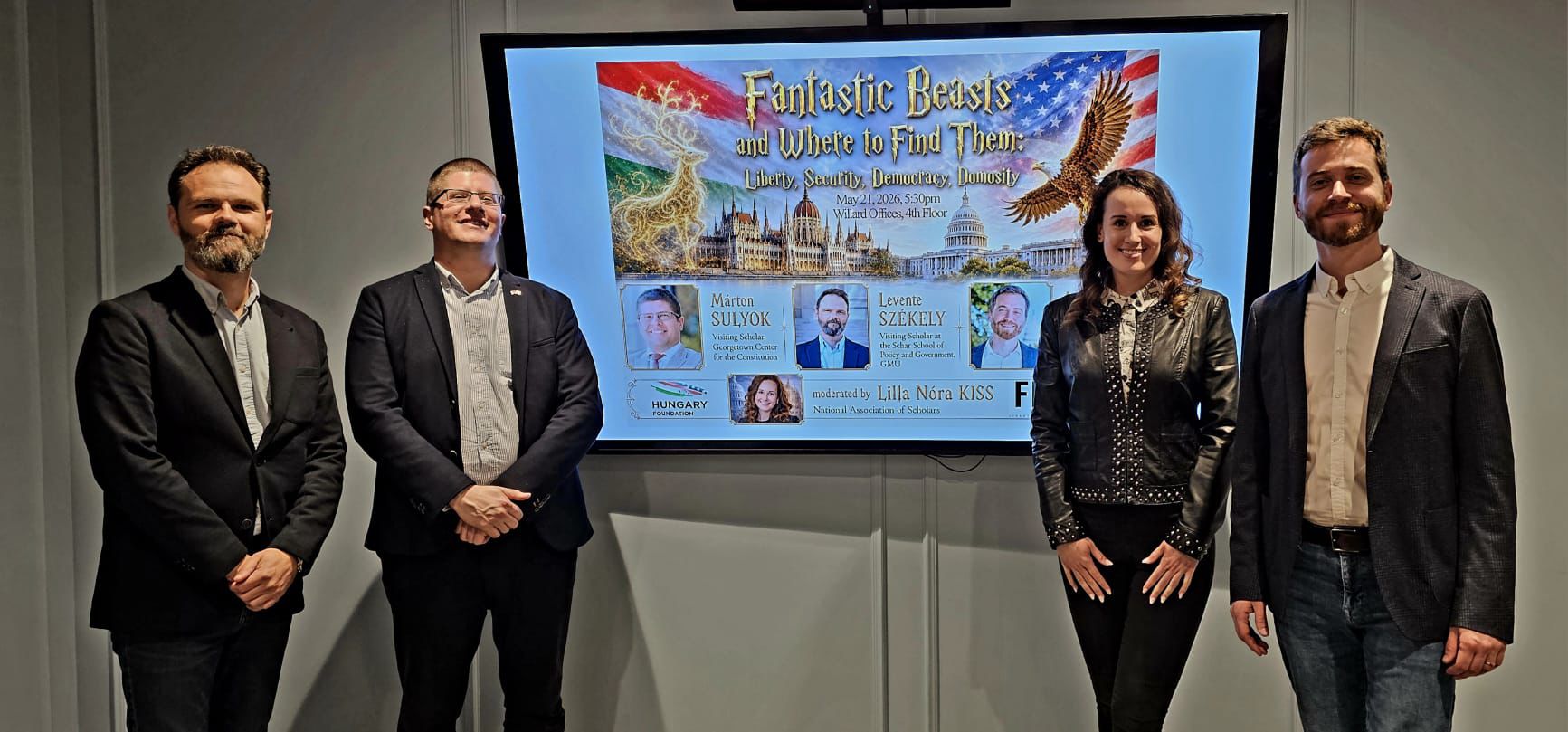
On May 21, Hungary Foundation hosted students, policy professionals, and members of the public for “Fantastic Beasts and Where to Find Them: Liberty, Security, Democracy, Domosity,” a thought-provoking panel hosted in partnership with Freedom and Identity in Central Europe (FICE). The event brought together three Hungarian scholars participating in Hungary Foundation’s Post-Graduate Visiting Research Fellowship Program, an initiative designed to strengthen academic and intellectual ties between Hungary and the United States through research at leading American institutions.
The evening featured presentations by Dr. Levente Székely, Visiting Scholar at George Mason University’s Schar School of Policy and Government, Dr. András Bethlendi, Visiting Scholar at Duke University School of Law, and Dr. Márton Sulyok, a Visiting Scholar at the Georgetown Center for the Constitution. The discussion was moderated by Lilla Nóra Kiss of the National Association of Scholars.
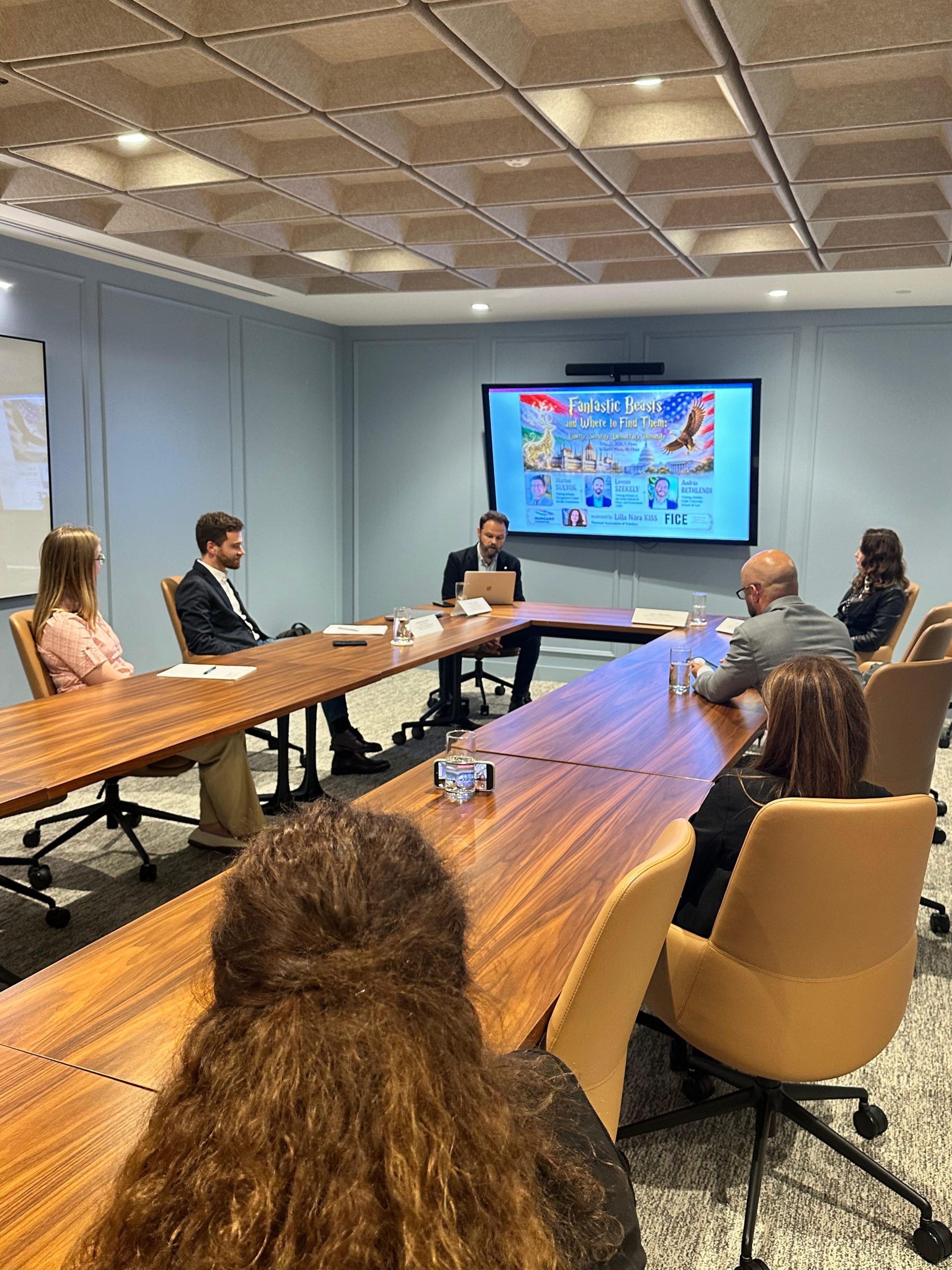 Levente Székely presented comparative research examining how Hungarian and American young people envision the future. Drawing on extensive visuals, charts, and survey data, Székely explored the values, anxieties, and aspirations shaping the next generation on both sides of the Atlantic. One of the clearest findings was that young people in both countries remain broadly hopeful about the future despite political polarization, economic uncertainty, and rapid technological change.
At the same time, his research revealed important cultural differences. Székely explained that Hungarian respondents consistently placed greater emphasis on family, stability, and personal relationships when imagining the future, while American respondents expressed significantly higher levels of concern about climate change and environmental risks. Both groups showed strong interest in artificial intelligence and emerging technologies, though they approached these developments from different social perspectives. This presentation highlighted the importance of understanding how national culture continues to shape generational priorities even in an increasingly globalized and digital world.
András Bethlendi introduced attendees to the concept of “domosity,” a term he coined in a recent publication, which describes a deeper sense of belonging and social rootedness within a political community. Bethlendi argued that democratic societies often focus heavily on formal equality — equality before the law — and substantive equality, which concerns access to opportunities and material conditions. Yet, he suggested that these frameworks alone are insufficient if minority groups do not experience a genuine sense of home, attachment, and recognition within their society. According to Bethlendi, a lack of domosity can leave individuals feeling socially detached even when legal protections and institutional equality are present. His remarks sparked a lively discussion about citizenship, identity, and social cohesion in modern democracies, particularly as Western societies grapple with questions of integration and cultural belonging.
Drawing on both European and American legal traditions, Márton Sulyok examined how constitutional democracies respond to digitalization, algorithmic governance, and AI-driven decision-making. His research focuses on whether constitutional frameworks developed in the twentieth century remain capable of constraining state and private power in an era increasingly shaped by automated systems, platform governance, and data-driven regulation.
Sulyok also emphasized the importance of transatlantic dialogue, contrasting the European Union’s precautionary and rights-centered regulatory approach with the United States’ comparatively innovation-oriented and market-driven model. Rather than endorsing either framework outright, his work explores how democratic states can balance technological innovation with constitutional safeguards and the rule of law.
Together, the three fellows demonstrated the intellectual breadth of Hungary Foundation’s fellowship program and its mission to foster deeper transatlantic dialogue. The evening underscored how emerging scholars from Hungary are contributing meaningful perspectives to some of today’s most pressing debates surrounding democracy, technology, identity, and the future of Western societies.