
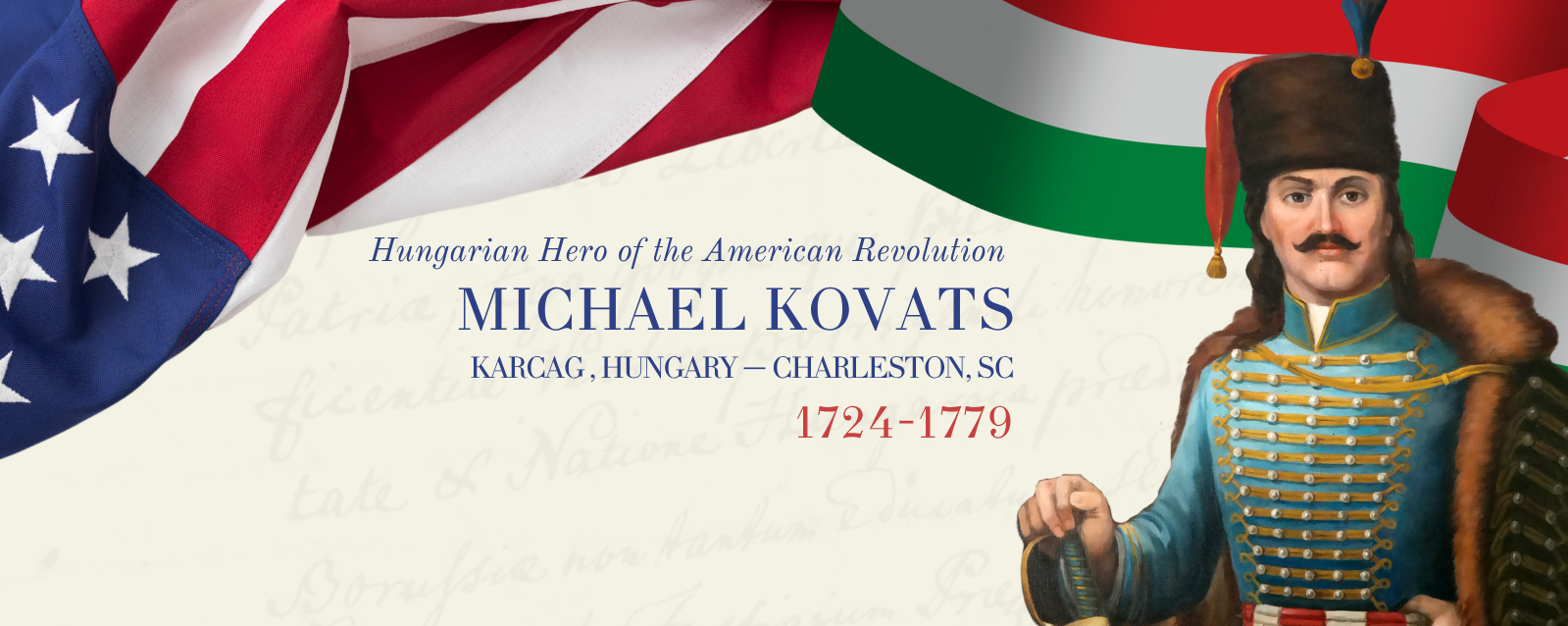
Support our America250 Hungarian Hero Campaign!
Michael Kováts de Fabriczy, a Hungarian war hero, played a crucial role in securing America’s independence during the Revolutionary War. Though honored in both Hungary and the United States, he has not yet received the recognition he deserves in Charleston—the very place where he gave his life for American freedom.
As the nation approaches the 250th anniversary of its founding, the Hungary Foundation has launched an effort to commission a monumental equestrian statue to permanently honor his courage and sacrifice.
Be part of this historic tribute—make your gift today and help bring this powerful memorial to life.
Commemorate Courage.
Celebrate Freedom.
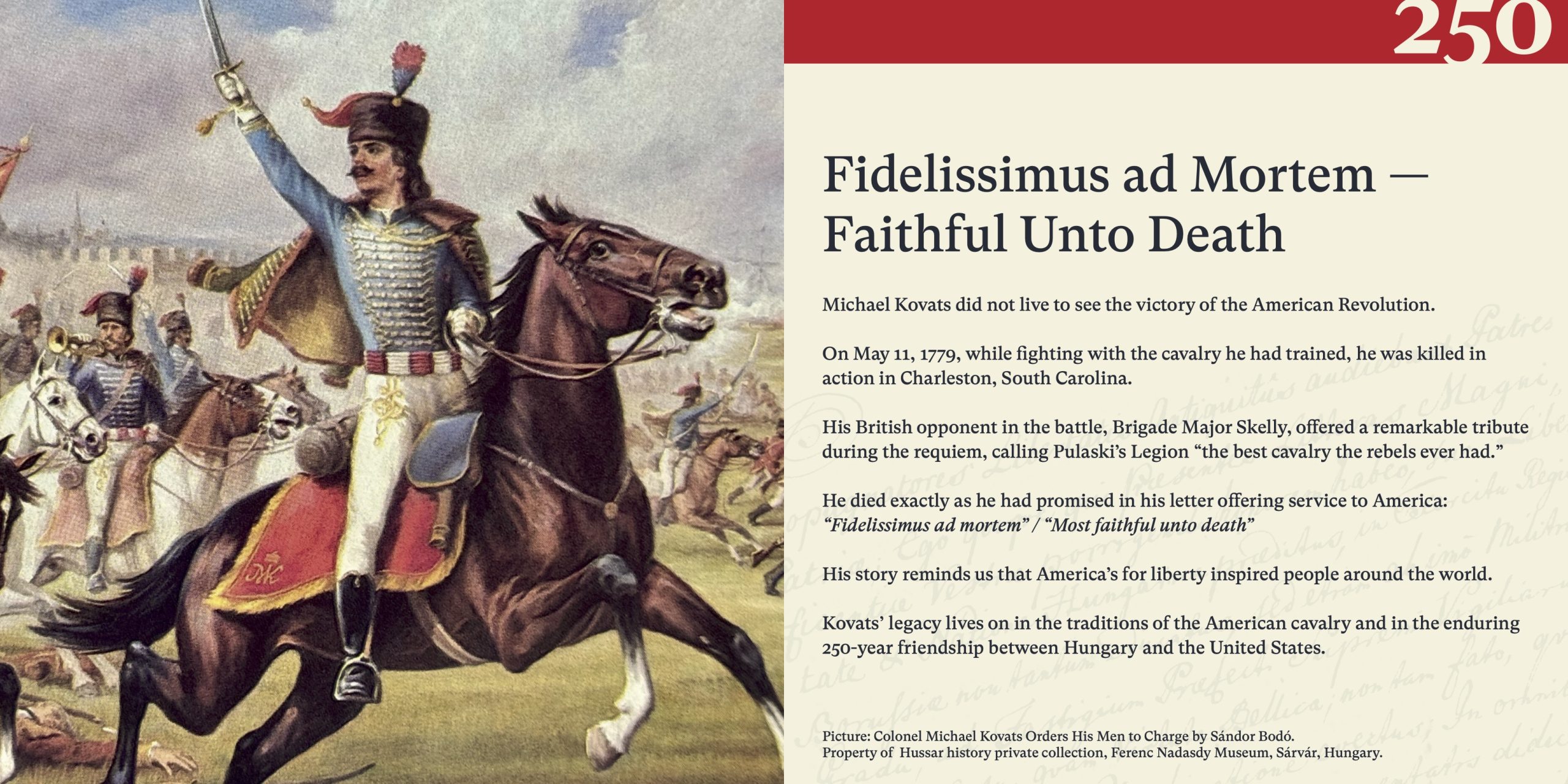
Who was Michael Kováts de Fabriczy?
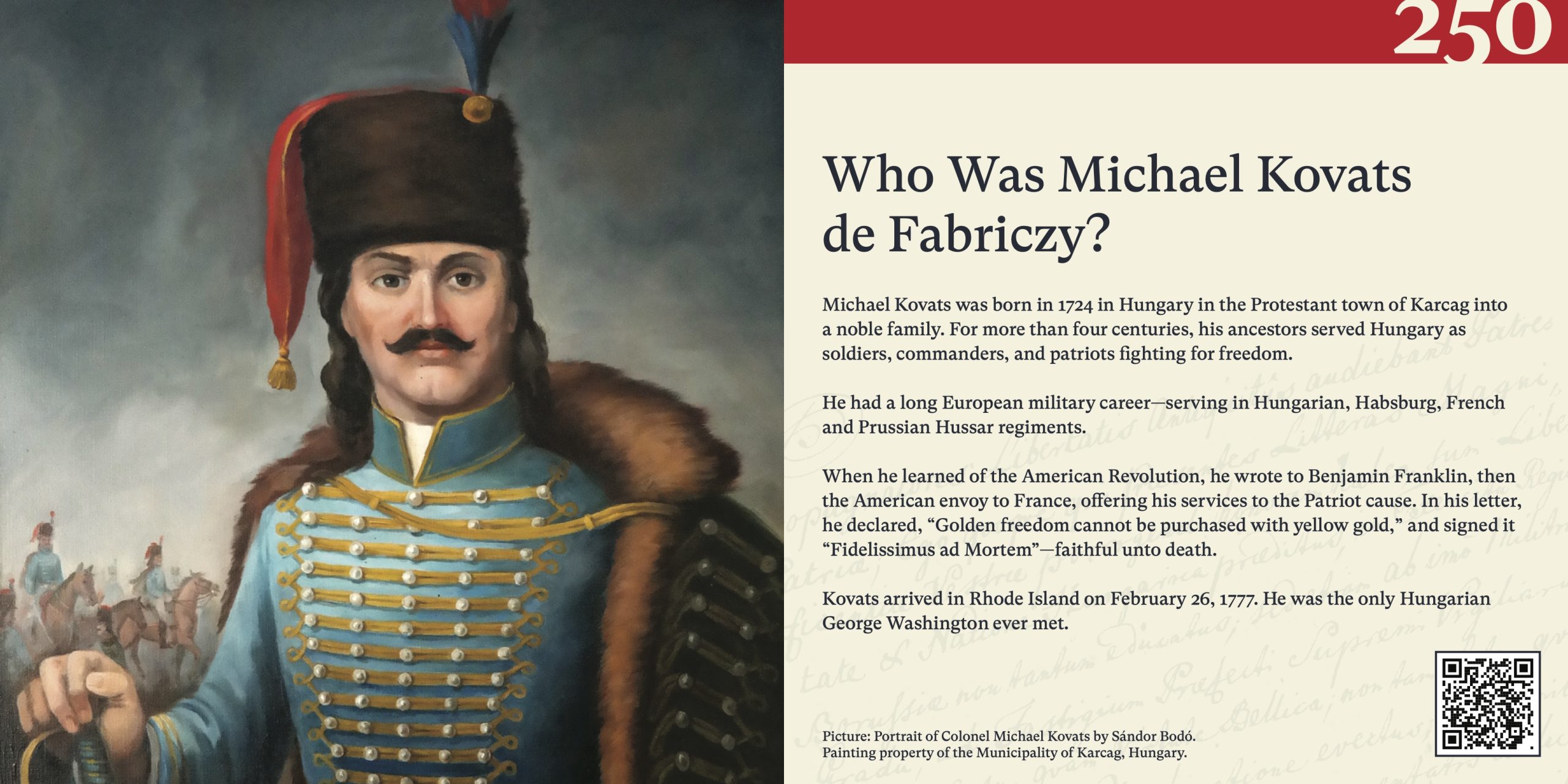
Michael Kováts (also spelled Kovats, de Kovats) was born in 1724 in the Kingdom of Hungary (in the Protestant town of Karcag) into a noble family. He had a long European military career—serving in Hungarian Hussar regiments in the Habsburg empire, the French Bercsényi Hussar Regiment, and the Prussian Székely Hussars. He later volunteered for service in the American Revolutionary War, offering his experience to the Continental Army.
Why is he called the “co-founder of the American cavalry”?
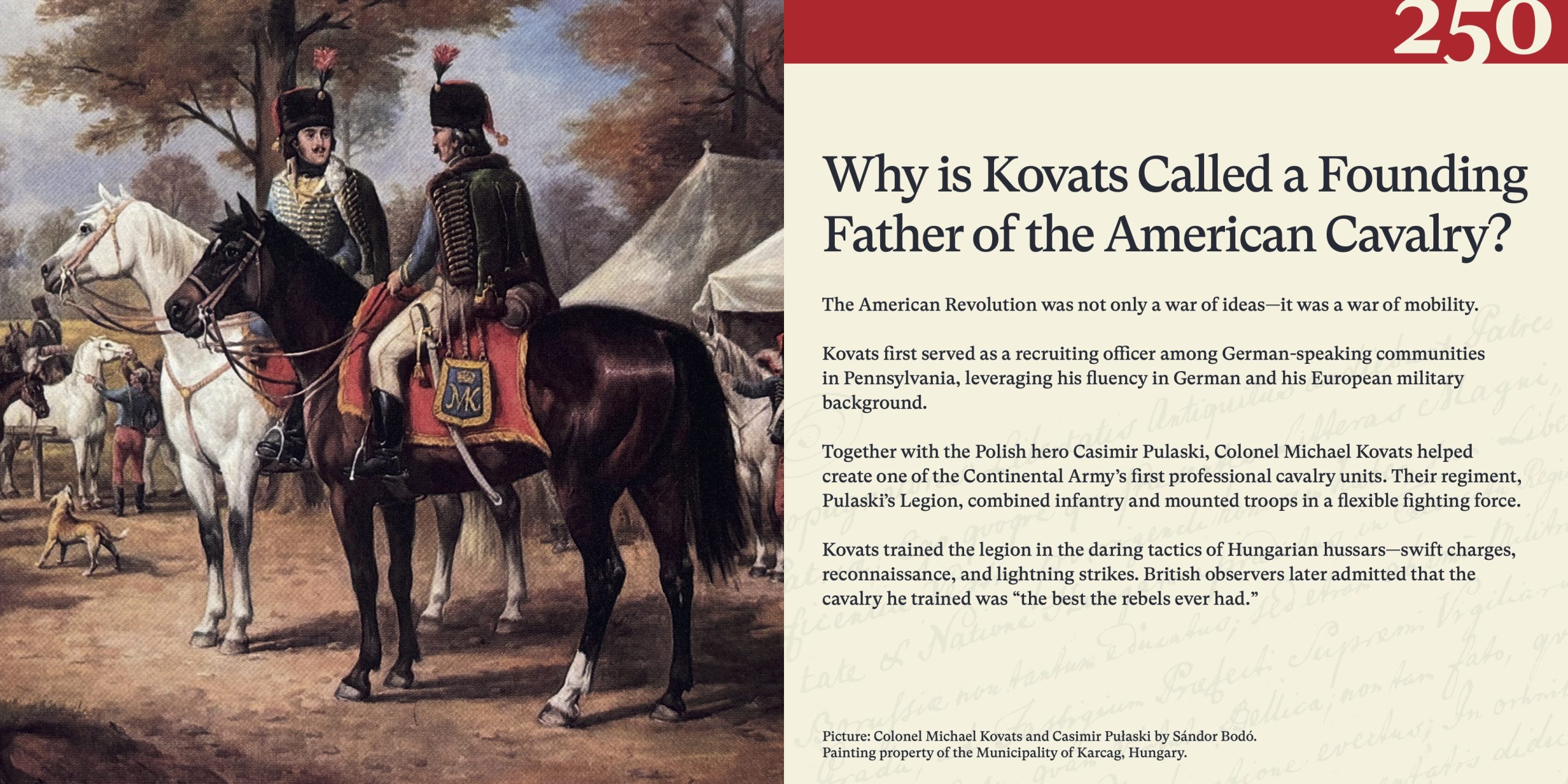
Though not always as well-known as some of his contemporaries, Kováts played a pivotal role in building the mounted forces of the Continental Army. He helped organize, train, equip and recruit for cavalry units—bringing European cavalry discipline and structure into the American context. A British officer reportedly described his cavalry as “the best the rebels ever had.”
What prompted Kováts to join the American cause?
Kováts was inspired by coverage in European newspapers of the American Revolution (the Pressburger Zeitung in the Habsburg realm had published extensively on the war). He wrote a letter in Latin to Benjamin Franklin in January 1777 offering his services, where he emphasised his own military virtues and his voluntary commitment to the American cause.
How did his arrival in America unfold?
Kováts arrived in Rhode Island on February 26, 1777. He met with George Washington on May 16, 1777, although the language barrier required an interpreter.
What were his early contributions to the Continental Army?
Kováts first served as a recruiting officer among German-speaking communities in Pennsylvania, leveraging his fluency in German and his European military background. He then became an adviser to Casimir Pułaski (a Polish nobleman also establishing a cavalry legion) and helped shape the cavalry’s organization, uniforms, equipment, and structure—areas where Pułaski lacked direct experience.
Did Kováts receive a formal command?
Yes. In early 1778, Pułaski recommended that Washington appoint Kováts as drillmaster for the cavalry. Although Washington hesitated about placing foreigners in senior roles, Kováts was eventually appointed as training officer. Then, on April 18, 1778, Congress formally appointed him to the rank of colonel (“de Kowatz”) in the Corps later known as the Pułaski Legion.
What about his battlefield service and death?
The southern campaign was critical. In early 1779, the Pułaski-Kováts Legion was ordered south to reinforce the war in the Carolinas. On May 11, 1779, during a skirmish near Charlestown (present-day Charleston), South Carolina, Kováts fell from his horse during the retreat and was killed. His exact burial site remains uncertain.
What is his legacy in America and Hungary?
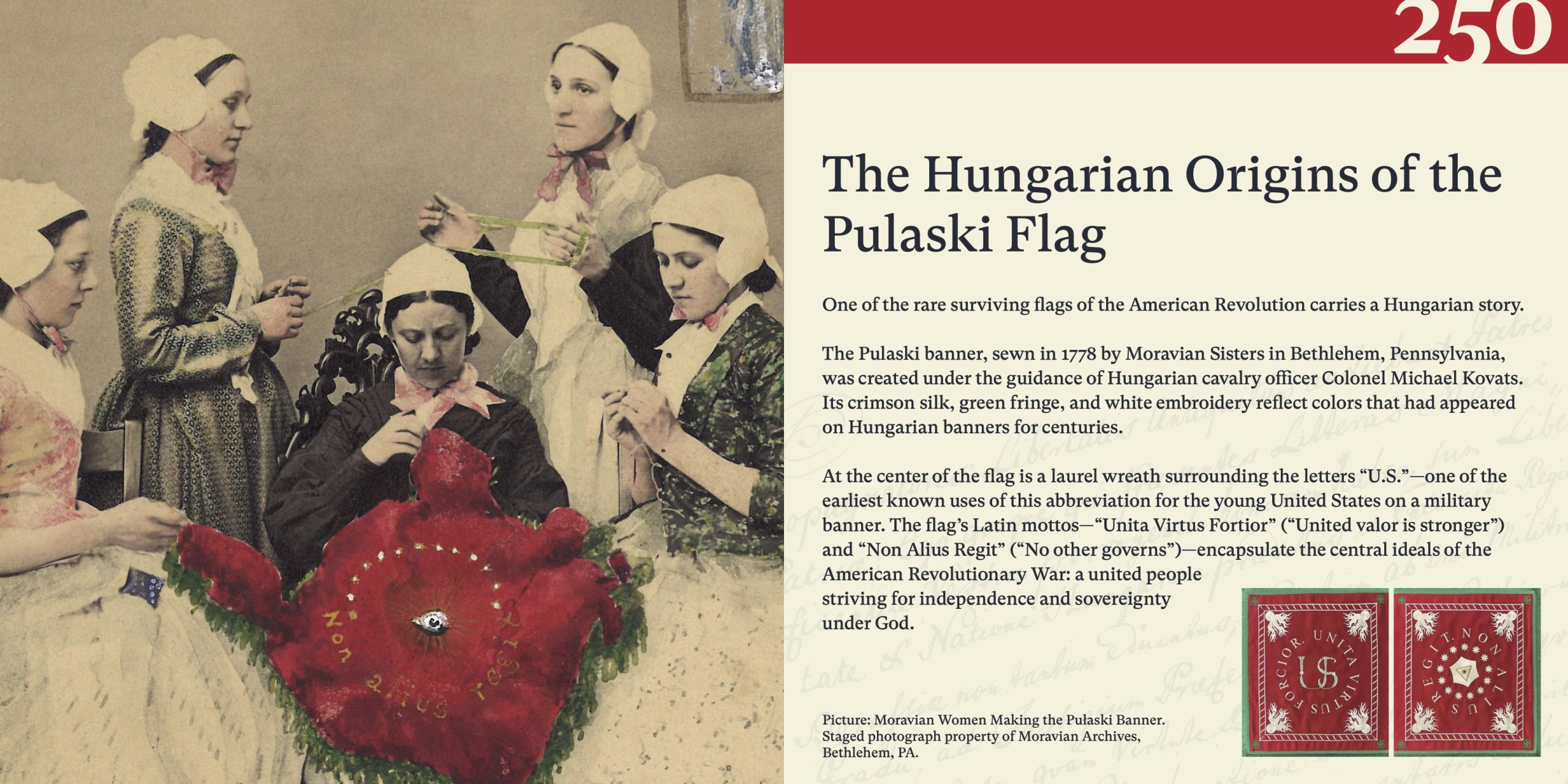
Kováts is commemorated both in the United States and in Hungary. In the U.S., memorials include the “De Kováts Triangle & Playground” in New York City, an equestrian bronze relief at the New York Historical Society, and multiple memorials in Washington, D.C. In Charleston, a marker by the Daughters of the American Revolution and a reproduction of the red-white-green flag designed by Kováts are among his honors. In Hungary his role is increasingly recognized in the context of Hungarian–American heritage.
Why is his story still relevant today?
Kováts’s story offers multiple angles of relevance:
- It highlights the international dimension of the American Revolution and the contributions of foreign-born officers to American independence.
- It illustrates how military expertise, when transplanted from European experience to the American theatre, helped shape data-starved, young armies into more effective forces.
- From a heritage and cultural diplomacy perspective, Kováts is a figure linking Hungary and the United States through shared history, offering a platform for collaborative commemoration (especially as the U.S. approaches its 250th anniversary of independence).
Are there remaining open questions or avenues for research about Kováts?
Yes. Among the unresolved issues:
- The exact location of his grave remains unknown, though efforts continue to locate it near Huger Street in Charleston.
- His contributions have been overshadowed in many popular narratives by more-famous officers like Pułaski; deeper scholarship may further clarify and raise his role.
- The story of how his European experience translated into American military practice invites further study (e.g., comparison of Hussar tactics, recruitment among German-speaking immigrants, equipment logistics).
Shop our Golden Freedom Store on Shopify
Educational Resources for Schools and Civic Organizations
- Meet Michael Kovats – Educational Booklet for Preschool Age Kids (in English and in Hungarian)
- Michael Kováts, The Hungarian Hero of the American Revolution – Educational Booklet for Elementary Age Kids and Older (in English and in Hungarian)
- Rollups, Flyers, Brochures and More Ready for Printing
- Kifestő és Foglalkoztató




2024 marked the 300th anniversary of the birth of Michael Fabriczy Kováts, “father of the US cavalry”. In celebration, the Karcag-based Michael Kováts Friendship Society (represented by Zoltán Pintér and László Örlős), the DC-based Kossuth Foundation (represented by Sándor Végh) and the Hungary Foundation (represented by Anna Smith Lacey) signed a cooperation agreement to preserve and promote his legacy in Hungary and in the US and form the Michael Kovats Memorial Committee.
Colonel Kováts played a vital role in organizing and leading the American cavalry units in the southern theater of war, where the Americans were weakest. His British opponent even remarked that Kováts’ units were “the best cavalry the rebels ever had”. Kováts eventually gave his life for the cause of liberty, he died at the battle of Charleston, South Carolina on May 11, 1779.
Kovats’ legacy is an inspiring example of heroism, perseverance, and commitment to liberty.
— Jimmy Carter
A famous Hungarian to who American history owes so much.— Ronald Reagan
Living and dying on his horse, an animal known for its strength and free spirit, Kováts exemplified the characteristics of the chargers who carried him into battle throughout his career: stamina, steadfastness, heart, and courage, an independent mind following the bugle call for “golden freedom.” — Renée Critcher Lyons
Because of their contributions to the American army and the sacrifices they made on the battlefields of Charleston and Savannah, Pułaski and Kováts remain enduring sources of pride for Americans of Polish and Hungarian descent.— Ethan S Rafuse
BILINGUAL BIOGRAPHY BOOK OF MICHAEL KOVATS

Dr Zoltán Árpád Pintér’s Book on Michael Fabriczy Kováts by Zrínyi Press
If there ever was a chapter for Hungarian Hussar officers in the imaginary golden book of famous military figures, Colonel Commandant Michael Kováts de Fabriczy would probably be included. This volume is a tribute to Mihály Kováts and to the earlier work of researchers who have explored his life. At the same time, it opens a window into the world of the 18th century Hussar officer, through which we can follow the logic of the times and the rise of an ambitious and talented warrior. No new scholarly volume on our hero has been published for nearly four decades. The improved accessibility of archives at home and abroad (Austrian, German, American) and the emergence of new research materials and sources have made it possible to expand the exploration of Kováts’ life. Cover: 244 pages Size: 20 × 26 cm Language: English and Hungarian Binding: Hardcover Author: Pintér Zoltán Árpád ISBN 978 963 327 808 6 Year of publication 2021
Michael Kovats Memorials Across the United States
- De Kovats Triangle and Playground – New York City, NY
- Michael de Kovats Equestrian Bronze Relief by Alexander Finta (New York Historical Society) – New York City, NY
- Michael Kovats de Fabricy Equestrian Statue by Paul Takacs (Embassy of Hungary) – Washington, DC
- Equestrian Statuette by Alexander Finta (Society of the Cincinnati) – Washington, DC
- Portrait of Michael Kovats (Kossuth Foundation) – Washington, DC
- Bronze Memorial Relief by Alexander Finta (The Citadel) – Charleston, SC
- Painting of Kovats Charge Reenactment by Ilona Bodo (Daniel Library of the Citadel) – Charleston, SC
- Mural of Pulaski and His Officers (Historic Hotel Bethlehem) – Betlehem, PA
- Kovats’ Letter to Benjamin Franklin (Library of the American Philosophical Society) – Philadelphia, PA
- Permanent Exhibit on Michael Kovats (Cleveland Hungarian Museum) – Cleveland, OH
- Colonel Commandant Michael Kovats Medal of Freedom (American Hungarian Federation) – Washington, DC
- Col Commandant Michael de Kovats of Hungary Bicentennial Coin (City of Charleston) – Charleston, SC
- Historic Marker Michael Kovats de Fabricy (Old Exchange and Provost Dungeon) – Charleston, SC
- SS Michael de Kovats World War II Liberty Ship
Literature and Music
- Portrait of a Soldier: A play in one act by Anna Egyud
- Apotheosis of Col. Commandant Michael Kovats de Fabricy: A play in three acts by Alexander Finta
- Col. de Kovats March by László Szabó, music by Gyula Horváth
- Kováts Festival March by Alexander Finta, music by Francis Gromon
Books and Resources on the Life of Michael Kovats
BOOKS
- Michael Fabriczy Kovats by Dr. Zoltán Pintér
- Az amerikai függetlenségi háború magyar hőse: Kováts Mihály ezredes élete, 1724-1779 by Aladár Póka-Pivny and József Zachar
- Foreign-born American Patriots by Renée Critcher Lyons
- Soldier of Liberty by Clarence A Manning
ARTICLES
- Colonel Commandant Michael Kovats de Fabricy of the Pulaski Legion by Elemer Bakó
- The Two Horsemen of the Revolution by Ethan S Rafuse
- The Hussar Who Fought and Died for America’s Freedom by Anna Smith Lacey and Marc Wheat
- Honoring a Hero of the American Revolution by DAR
- Most Faithful Unto Death by Lili Zemplényi
- The Forgotten Hungarian Origins of the Pulaski Banner by László Örlős
- Colonel Michael Kovats: The Hungarian Co-founder of the American Cavalry by Zoltán Pintér and Anna Smith Lacey
- An 18th-century battle flag sewn in Bethlehem, Pa., tells a little-known tale of the American Revolution – by Anna Smith Lacey and László Örlős
Events (Past and Upcoming)
- May 10, 2024 – Kick-off Event of Michael Kovats Memorial Year (Karcag, Hungary)
- October 25, 2024 – Commemoration and Book Launch, Kossuth House, Washington DC
- October 27, 2024 – Commemorative Panel and Book Talk, Old Exchange Building, Charleston, SC
- October 30, 2024 – Book Launch, New York City, NY
Congressional Action
H.J.Res.435 – 96th Congress (1979-1980): A joint resolution designating November 30, 1979, as “Colonel Commandant Michael Kovats Memorial Day”. Contributor: House of Representatives – Biaggi, Mario – 96th Congress Date: 1979-10-30 H.J.Res.564 – 98th Congress (1983-1984): A joint resolution designating May 11, 1984, as “Colonel Commandant Michael Kovats Memorial Day”. Contributor: House of Representatives – Biaggi, Mario – 98th Congress Date: 1984-05-08 H.J.Res.298 – 97th Congress (1981-1982): A joint resolution designating May 11, 1982, as “Colonel Commandant Michael Kovats Memorial Day”. Contributor: House of Representatives – Biaggi, Mario – 97th Congress Date: 1981-07-01 H.J.Res.1040 – 94th Congress (1975-1976): A resolution to authorize the Committee for an American Hungarian Bicentennial Monument, Inc., to erect a monument in honor of the late Col. Michael Kovats de Farbrici … Contributor: House of Representatives – 94th Congress – Gude, Gilbert Date: 1976-08-02
