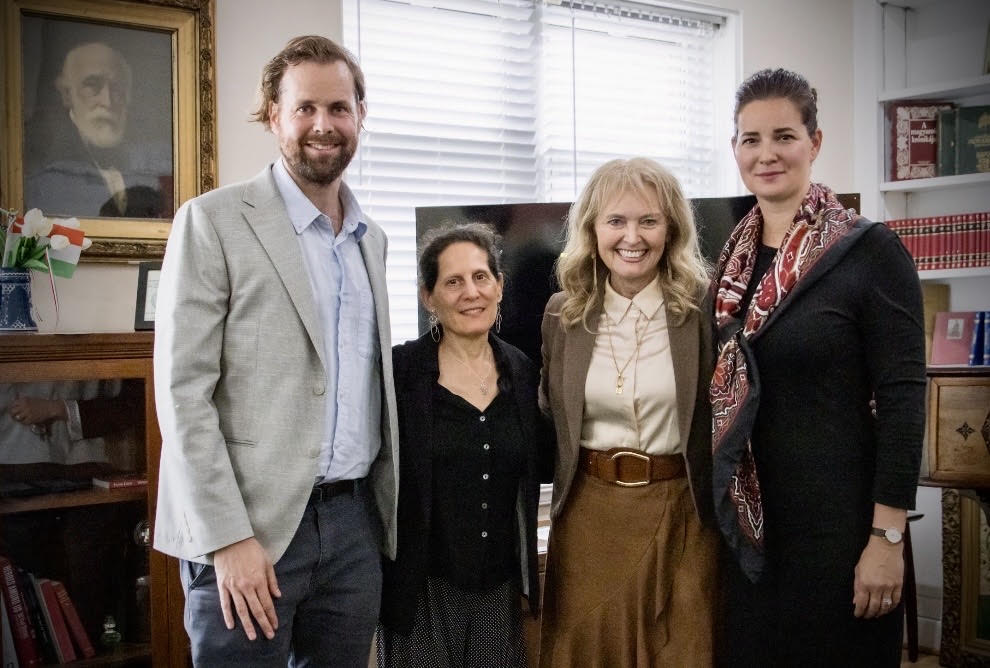
HF Alumnus Barna Szász, Nancy Gillette (USHMM), Katrina Lantos Swett, Anna Smith Lacey
On September 23, a full house gathered at Kossuth House in Washington, D.C., for “Augmented Reality & Holocaust Memory: Inside the Museum and Out on the Street.” The afternoon looked at how augmented reality (AR) can bring people closer to Holocaust history in two settings: a gallery of the United States Holocaust Memorial Museum, and the streets of Budapest’s former Jewish ghetto. There, three Hungary Foundation alumni are building If These Streets Could Talk: director Barna Szász and producers Máté Artur Vincze and Noémi Szakonyi. Hungary Foundation Executive Director Anna Smith Lacey moderated the discussion.
Dr. Katrina Lantos Swett, President of the Lantos Foundation for Human Rights & Justice, opened the program by speaking about members of her family who were lost in the Holocaust. She is one of the last people, she said, for whom this history is not distant. Every morning she has breakfast with her mother, a survivor, who is now 95.


Nancy Gillette, Special Exhibitions Manager at the Museum, presented the AR experience added to the Museum’s Tower of Faces exhibition. Work on it began in 2018, early for a museum of that size. With a tablet, visitors can now read and hear the stories of the people in the photographs. Gillette said those who use it spend five times as long in the Tower as those who don’t.
Szász, who now teaches AR storytelling at Stanford, explained why a documentary filmmaker would turn to augmented reality. In 2018, as a Fulbright scholar and Hungary Foundation graduate fellow, he saw an experiment in Jeremy Bailenson’s Virtual Human Interaction Lab at Stanford. People who had interacted with a virtual person sit in a real chair would not sit in that chair themselves, and most still avoided it after taking the headset off. To Szász, it showed that a virtual layer can change how people see the physical world around them. He started exploring AR to show histories that can no longer be seen in the places where they happened, first on the Stanford campus and later in Budapest’s Jewish quarter. AR, he said, is a new medium with its own language, different from film or anything that came before, and he has been learning that language together with his students.


If These Streets Could Talk puts that knowledge to work in Budapest. Szász described it as a new way for people to connect with the history of their cities, built on storyliving rather than storytelling. Characters from 1903 to 1944 walk up to visitors on the streets of the former Jewish quarter, and visitors have to make the decisions those people faced.
Joining by video, Prof. Victoria Grace Richardson-Walden, Director of the Landecker Digital Memory Lab at the University of Sussex and the project’s ethics lead, described how the team made If These Streets Could Talk into the first scientific research project on AR-native methods of Holocaust memory, meaning methods built for what AR can do that older media cannot. Its storyliving approach, and the ethical questions it raises, were tested in interviews with sixty participants. The results, she said, show that AR can deepen people’s understanding of the places where events happened and leave room for critical reflection. It also moves them emotionally, which makes them want to learn more.
The full experience opens to the public in Budapest in 2028.
We thank Dr. Katrina Lantos Swett, Nancy Gillette and Prof. Victoria Grace Richardson-Walden, and everyone who joined us for the event.
To support If These Streets Could Talk, visit if-these-streets.org/donate.
Support the project
Across Europe, streets and squares once alive with Jewish life have gone silent. When history becomes invisible, it is forgotten — and that creates fertile ground for misrepresentation.
If These Streets Could Talk is a new, tested methodology for future-proofing Jewish heritage and Holocaust memory through Augmented Reality. In Budapest’s former Jewish Quarter, audiences walk the actual streets and encounter holographic characters and 3D-reconstructed environments, past and present side by side — every scene rooted in archival evidence and survivor testimony.
The approach is validated, we are in main production, and Budapest is our proof of concept, not our ceiling. This is where we need you.
Updated daily · Last updated 21 September 2026
$1.4 million secured
Between 2022 and 2026 we built three AR prototypes and tested them scientifically with audiences. The methodology is validated.
Every dollar is doubled — until it isn’t
$450,000 of our funding only counts if we match it. $200,000 needs to be matched in 2026 and $250,000 in 2027. After that the match closes and the doubling is gone.
Choose what your donation goes toward
Each part of the work is funded by many donations together. Pick the one you want to be part of.
$100→$200
Please help contribute to the historical and visual research of one address, and to the 3D reconstruction of its shop fronts and signs.
$500→$1,000
$1,000→$2,000
Please help contribute to the educational methodology we are co-developing with the Haver Foundation.
$5,000→$10,000
Please help contribute to the interactive, non-profit AR platform that other cities can use for their own Jewish heritage.
$10,000→$20,000
Please help contribute to the volumetric 4DGS shoot that brings the historical characters to life as photorealistic holograms.
Any amount
Every donation is matched while the match lasts, whatever its size — you choose the amount.
Donations made here go to Párhuzamos Történetek Kulturális Egyesület, the non-profit association behind the project.
Donors in the US: for a tax-deductible donation, please donate through our fiscal sponsor Edge of Discovery, a 501(c)(3) public charity in Utah — write to hello@barnaszasz.com and we’ll send you the details.
Considering a larger donation? Meet director Barna Szász for 30 minutes, in person or on Zoom, or write to hello@barnaszasz.com.