
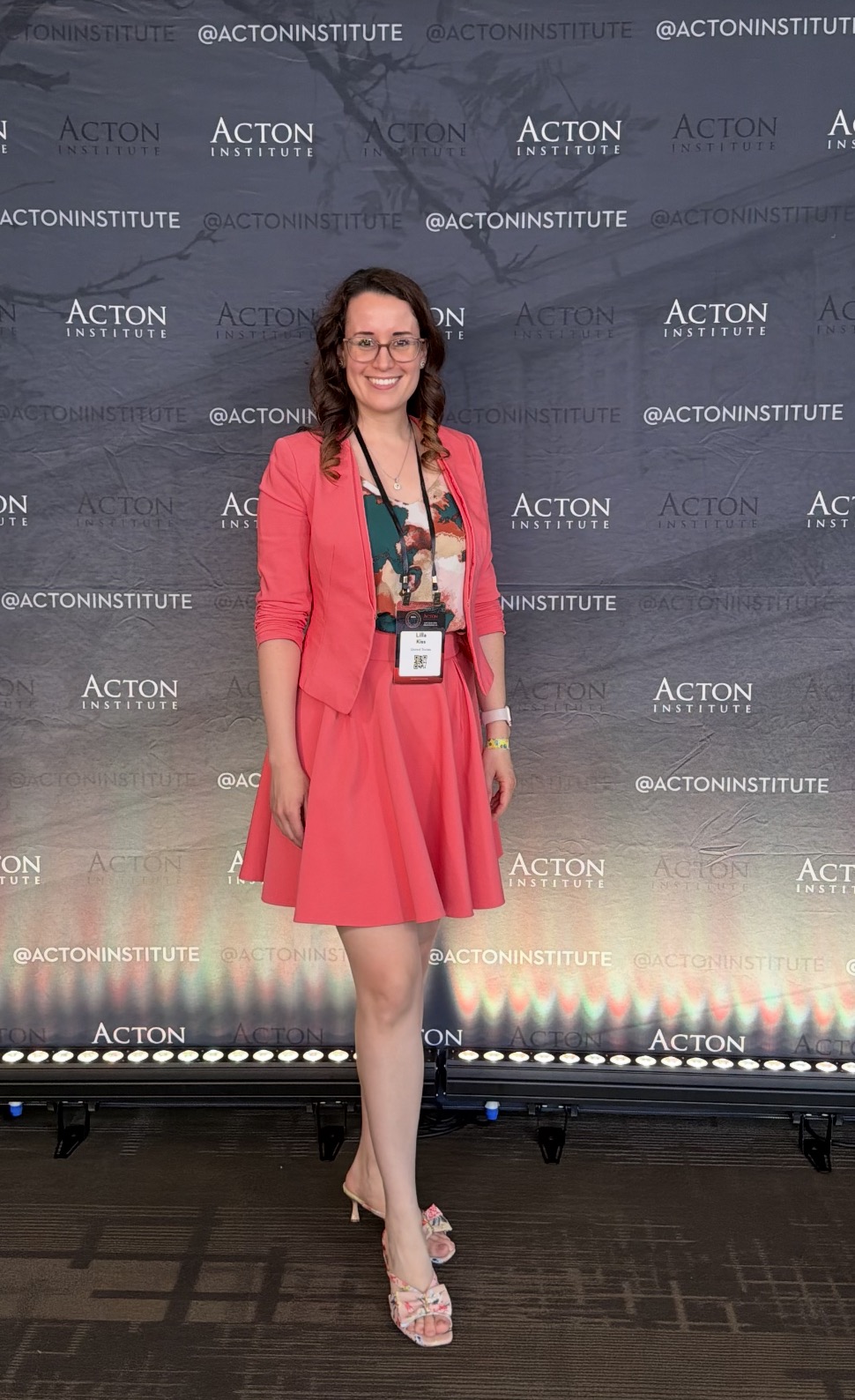
Lilla Nóra Kiss
This spring, Lilla Nóra Kiss, PhD, Senior Fellow for Academic Integrity and International Affairs at the National Association of Scholars, brought her expertise to two very different audiences — one focused on the cutting edge of technology regulation, the other on the philosophical roots of a free society.
On May 13, 2026, Kiss traveled to San Francisco for Antitrust West Coast, joining roughly 50 practitioners, policymakers, and academics working in competition law. Rather than simply attending, she spoke on two panels. The first tackled how competition authorities should approach the fast-moving AI ecosystem, from supply-chain competition to the risks of imposing premature, rigid rules on a still-evolving technology. The second examined the European Union’s Digital Markets Act and the widening gap between European and American approaches to digital competition, making the case for evidence-based enforcement that addresses real harm without undercutting innovation.
Her remarks struck a chord.
“The presentations generated positive feedback and engaged discussion, particularly regarding the practical effects of the DMA and the need for evidence-based, innovation-conscious AI regulation,” – Lilla Nóra Kiss
The conference also sharpened her professional standing.
“Attending the event strengthened my professional network by connecting me with leading antitrust practitioners, policymakers, academics, and industry representatives,” she noted. “The experience reinforced my confidence in contributing to high-level international policy discussions.” – Lilla Nóra Kiss
Kiss plans to fold what she learned in San Francisco into her research, teaching, and future publications on AI and digital competition.
Six weeks later, Kiss’s focus shifted from courtrooms to something more foundational. On June 23, 2026, she joined roughly 1,000 attendees from 80 countries in Grand Rapids, Michigan, for Acton University, a program exploring the moral, economic, and religious underpinnings of a free society. Kiss attended without presenting, taking in the wide-ranging program as a participant.
The scale and diversity of the gathering left a mark.
“Acton University broadened my interdisciplinary understanding of the moral, economic, religious, and philosophical foundations of a free society and connected me with scholars, policy professionals, religious leaders, and practitioners from diverse backgrounds,” Kiss reflected. “The event was intellectually stimulating and provided renewed motivation to connect my academic and policy work with broader questions of liberty, virtue, and human flourishing.”
She intends to weave those ideas into her research, teaching, and policy work going forward, particularly as she examines the relationship between economic freedom, human dignity, and responsible governance.
Taken together, Kiss’s spring reflects the dual nature of her work: equally at home shaping technical antitrust and AI policy debates as she is engaging with the deeper philosophical questions underpinning a free society.
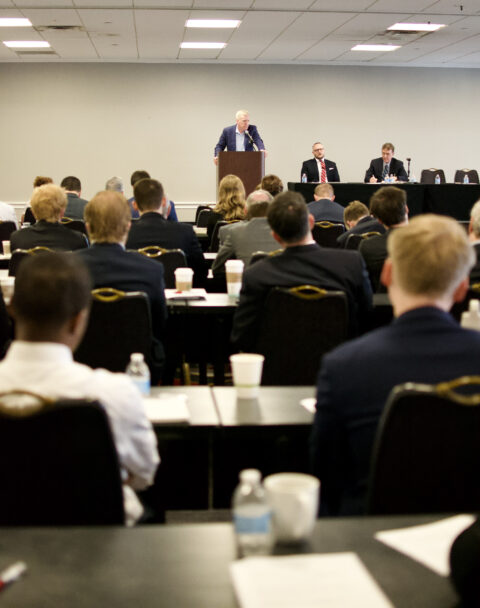 This Summer, Dr. Tamás Boldizsár Hajas-Janka, an alumnus of the Széll-Kálmán Program and an Edmund Burke Fellow currently serving as Legal and Policy Advisor for Trade and Investment at the Hungarian Ministry of Foreign Affairs, traveled to College Park, Maryland, to join roughly 80 scholars, students, and practitioners at The Roots of Ordered Liberty: America at 250, a conference hosted by the Center for the Philosophy of Freedom.
Held over two and a half days, the gathering brought together thinkers from across disciplines to examine the intellectual foundations of the American founding as the country approaches its 250th anniversary. For Dr. Hajas-Janka, the conference offered far more than an academic program — it became an occasion to deepen his understanding of American history and constitutionalism while forging relationships that he hopes will shape his career for years to come.
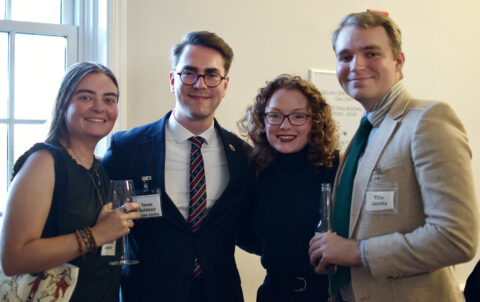
Attending as an Edmund Burke Fellow gave Dr. Hajas-Janka a seat among scholars from a wide range of backgrounds and disciplines, and, just as importantly, the chance to connect with fellow rising professionals in a lasting way. Several of the friendships he formed over the course of the conference, he says, have the potential to grow into long-term collaborations and partnerships.
Beyond the ideas exchanged in formal sessions, Dr. Hajas-Janka came away with something harder to teach: a fuller sense of Americans themselves. That combination — rigorous engagement with America’s constitutional tradition alongside genuine personal connection — is precisely the kind of experience the Hungary Foundation’s fellowship programs are designed to cultivate.
“Attending the conference as an Edmund Burke Fellow allowed me to engage not only with scholars from different backgrounds and areas, but also to connect with talented peers in a meaningful way,” Dr. Hajas-Janka reflected. “Throughout the two and a half days spent at the conference, I could enrich my understanding of not just American history and constitutionalism, but Americans themselves. I believe that attending the conference supported my long-term transatlantic diplomatic aspirations both on an intellectual and personal level, and also provided inspiration and opportunity for scholarly work.” – Dr. Tamás Boldizsár Hajas-Janka
The conference didn’t just leave Dr. Hajas-Janka with new ideas — it opened doors. He plans to begin publishing on topics the event brought into focus, and says the conference offered not only inspiration but practical access to outlets where that work could appear. He also intends to stay in touch with the organizers and presenters he met in College Park, with an eye toward future cooperation — and toward returning next year not simply as an attendee, but as a presenter in his own right.
As he continues building his career at the intersection of law, trade policy, and diplomacy, Dr. Hajas-Janka plans to carry the connections and insights from The Roots of Ordered Liberty forward, using them as a foundation for further professional opportunities in the United States.