
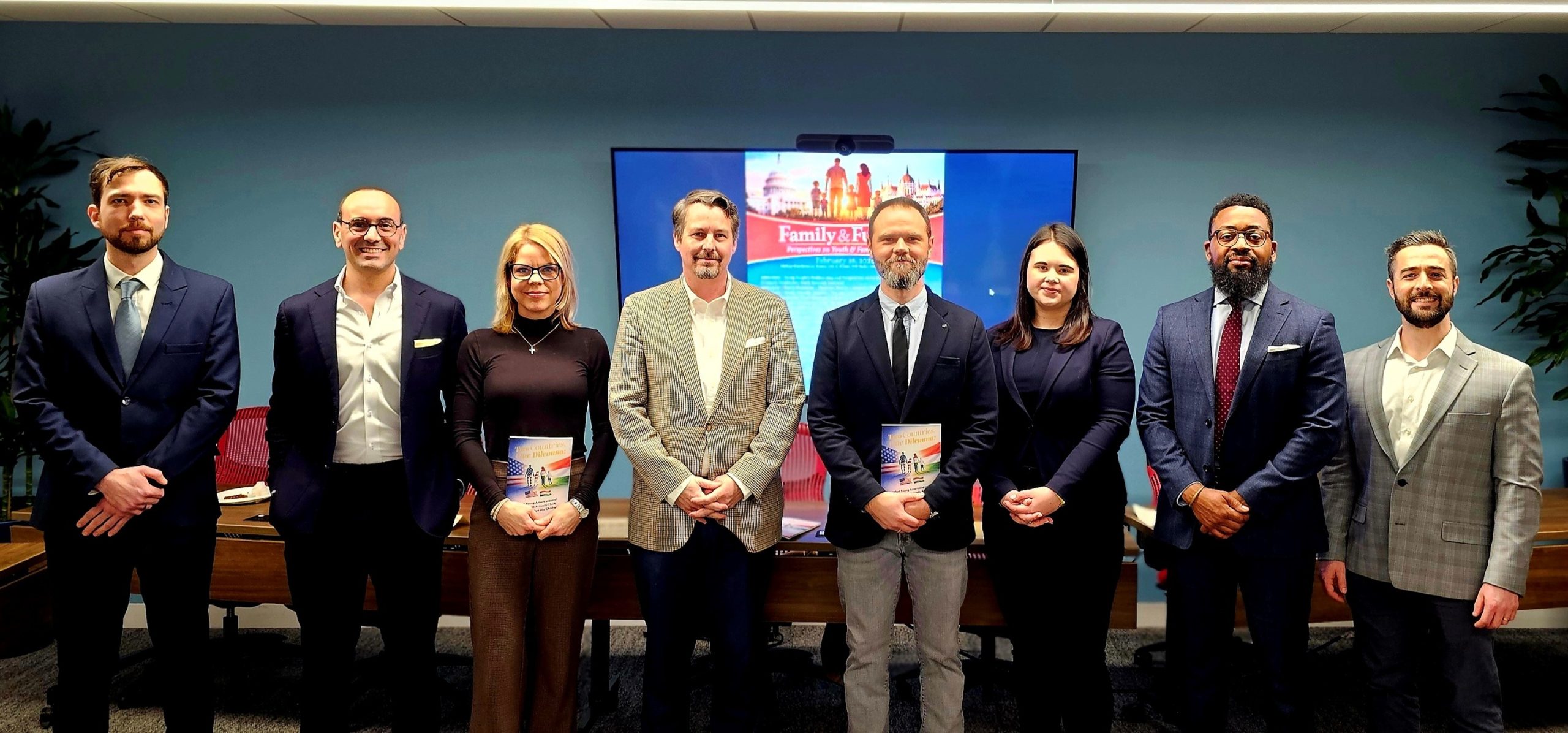
The Youth Research Institute and the Hungary Foundation held a conference titled Family & Future – Perspectives on Youth and Family Policy on February 25 in Washington, D.C. The conference aimed to discuss a topic that has received too little attention in the United States: the family. Upon arrival in Hungary, travelers are greeted at Liszt Ferenc International Airport by Family Friendly Hungary posters highlighting the country’s focus on family policy. Hungary is unique in this respect, as it allocates 5 percent of its budget to family support. In the United States, the institution of the family is approached from a fundamentally different perspective, with the issue being linked almost entirely to the private sphere and individual responsibility.


At the conference, alongside distinguished American speakers such as Emma Waters, Delano Squires, Brent Buchanan, Alexander Tarascio, Joseph Backholm, Ryan Shucard, and Chad C. Pecknold, we also heard from outstanding Hungarian experts, including Dóra Babos, Bálint László Tóth, and Georgina Kiss-Kozma. The Hungary Foundation was represented by our post-graduate fellow, Levente Székely.
At the event, we presented a joint report by the Youth Research Institute and Cygnal titled Two Countries, One Dilemma: What Young Americans and Hungarians Actually Think About Marriage and Children.
Research conducted in collaboration between the Youth Research Institute and Cygnal examined the plans and ideas of young people aged 15–39 in both countries, focusing on their views on family, the future, and the challenges they face.
Presentations and panel discussions revealed that most young people in the United States and Hungary still consider the two-parent family model ideal. However, starting a family is often postponed due to economic, career, and life uncertainties, so marriage and having children are typically seen as future goals.
Speakers emphasized the importance of the family as the basic unit of society, capable of ensuring the growth of future generations, a truth that persists despite ongoing cultural changes. Although Hungarian and American attitudes and practices regarding family are similar, the family policies of the two countries differ significantly. Speakers noted that, in terms of family policy, Hungary could serve as a role model for the United States, as family-friendly thinking permeates the functioning of the Hungarian state.